
Rockwall Projected Versus Actual Release
A projected release date is a planning estimate within a particular custody system. For a TDCJ prisoner, it can reflect the sentence, calendar time, credits that the law permits, and the possible release route. An actual release date records what happened. The event may be release to parole, discharge, mandatory supervision, transfer, or another outcome. Those terms are not interchangeable.
Rockwall’s Sheriff audit works at the county-jail level. It records an exact departure time and a reason such as bond, time served, judge release, or transfer to another authority. A “Released to DOC” entry means the person left Rockwall County custody and entered the state system. It does not establish when that person will leave TDCJ. Likewise, the state projected date says nothing about whether a pretrial detainee will post bond.
| Record | What it establishes | What it does not establish |
|---|---|---|
| Rockwall release audit | County departure time and recorded reason | Final release from a receiving state or federal authority |
| TDCJ projected date | Current state-system estimate | Guaranteed physical release |
| Board decision | Parole action or review result | Completion of release processing |
| Actual TDCJ status | Recorded state custody or release event | Outcome in an unrelated county or federal case |
Choose the Rockwall Release-Date Route
The last known custodian determines the route. Someone held at the Rockwall County Detention Center after arrest may be pretrial, serving a county sentence, waiting on a hold, or pending transfer. A pretrial detainee has no sentence-based projected date. Court scheduling, bond verification, magistrate action, and holds may affect departure, but none can be converted into a fixed release promise.
A person transferred to state prison belongs in TDCJ records. A sentenced federal prisoner belongs in the Bureau of Prisons locator. An immigration detainee belongs in the ICE system. Rockwall has no freestanding TDCJ, BOP, or ICE facility, yet the county audit records transfers to DOC and federal authority. A departure from the local jail can therefore be the first leg of continued custody.
- Check the Rockwall weekly Release Audit Trail for the county event and exact reason.
- If the person remains in active local custody, contact the Admissions and Release Desk at 972-204-7108 or review the court case. Do not invent a date for an unsentenced detainee.
- If the audit names DOC, search by TDCJ number or SID in the TDCJ offender search.
- Read the status and projected field in context. Record the date of the check, then inspect any parole status or sentence information that applies.
- Near the expected event, verify with TDCJ and use the proper custody-notification channel. Afterward, confirm the actual release or transfer record.
Search TDCJ Release-Date Fields
The TDCJ search covers the Texas prison system, not current active jailings in Rockwall County. Search by TDCJ number or State Identification number when known. A number is less prone to same-name error than a broad name search. If only a name is available, compare multiple identifiers and sentence details before accepting the match.
The official search page shows the fields available for a live query. Availability varies with the record and legal restrictions. A blank field should not be converted into “no release date,” and an old screenshot should not be treated as current evidence. If the record is unclear, use the official TDCJ contact route with the full name and number.
The TDCJ offender-search screen below is a useful visual reference for the state path. It does not search the Rockwall jail roster.
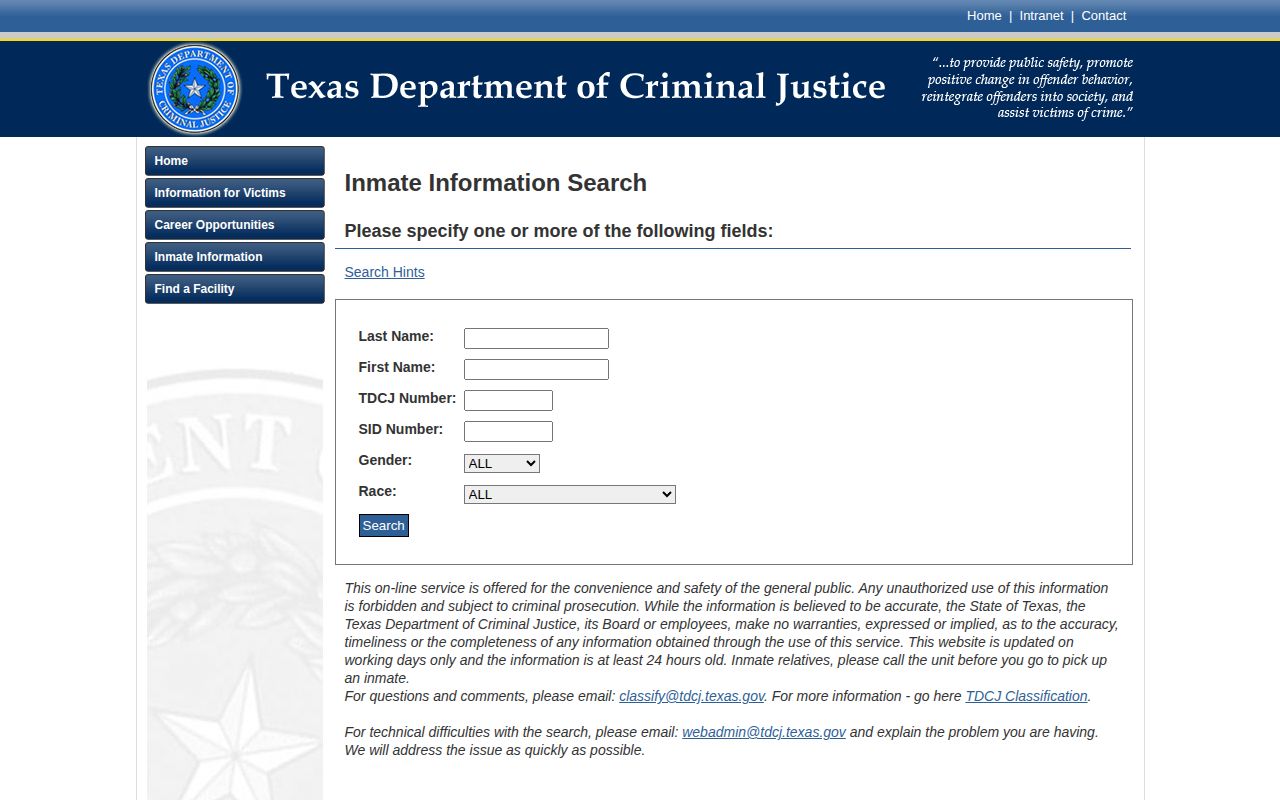
Use those official search controls for a state prisoner, then preserve the current status and date checked when communicating the result.
Texas Good Time Is Conditional
Texas does not impose a universal rule that every prisoner must serve 85 percent of a sentence. That shortcut is not a safe way to calculate a Rockwall County projected release date. Eligibility and credit effects depend on the conviction, sentence, and release mechanism. A date shown by TDCJ is more reliable than arithmetic built from the sentence alone.
Texas Government Code Chapter 498 governs good-conduct time and classification. Good time may affect eligibility and projected calculations when the law permits, but it is not a vested promise of early physical release. Credits can be forfeited or restored. Classification and disciplinary events may also change how TDCJ computes the estimate.
For many people convicted of offenses listed in Code of Criminal Procedure article 42A.054 or certain other serious offenses, Government Code section 508.145 generally measures parole eligibility by actual calendar time equal to one-half of the sentence or 30 calendar years, whichever is less, subject to exceptions. Good time does not count toward that stated threshold. Eligibility only permits consideration. It is not the date of release.
- Good-conduct time
- Credit governed by state law and TDCJ classification rules; its effect varies by case.
- Parole eligibility
- The point at which the Board may consider release, not a promise that it will approve release.
- Projected release date
- A current planning estimate that may change before the actual event.
- Detainer
- A request or hold from another authority that may prevent freedom after one custody ends.
Why Rockwall Release Estimates Change
A projected date is recalculated as the legal and custody record changes. Compare the newest TDCJ result with sentence data and Board action rather than trying to repair an old estimate by hand. When two screens conflict, the later official record may reflect an update, but the difference still deserves confirmation.
| Change | Possible effect | Best check |
|---|---|---|
| Good-time forfeiture or restoration | Moves an eligible calculation | Current TDCJ record and official explanation |
| Disciplinary or classification action | Changes credit treatment or release processing | TDCJ case record |
| Concurrent or consecutive sentence correction | Changes the sentence timeline | Judgment plus TDCJ calculation |
| Parole approval, denial, or later review | Changes the available release route | Board decision and TDCJ status |
| Detainer, warrant, or new sentence | May continue custody after one term ends | Receiving agency and court record |
| Corrected identity or data | Replaces a stale or mistaken display | Originating agency confirmation |
“Entered In Error” also appears in Rockwall’s own release-reason vocabulary. Administrative correction is therefore not an abstract concern. For a county event, ask the release desk for the corrected event history. For a state calculation, contact TDCJ rather than treating a cached page as permanent.
Rockwall Parole Dates Need Context
The Texas Board of Pardons and Paroles makes parole decisions. Its process is usually an administrative file review, and no public calendar of individual Rockwall hearings was established. A decision may approve release, deny it, impose conditions, or set a later review. Read the exact Board terminology on the official vote-options page.
A favorable decision still precedes administrative release processing. It does not prove the person has walked out of a unit. Conversely, a projected field is not proof of a favorable vote. Once release occurs, the record must show whether it was parole, mandatory supervision, discharge, or transfer. Someone on parole has left confinement but has not reached unconditional discharge.
The Rockwall parole and probation page separates Board decision making, TDCJ supervision, and local court probation. That distinction prevents a county probation office from being treated as the source for a state-prison release date.
County Detainees May Lack Dates
A person in the Rockwall County Detention Center before trial has no sentence from which to compute a projected date. The jail FAQ says magistrations occur seven days a week with no fixed time and can take up to 48 hours. After a bond is delivered and verified, release can take up to four hours only if no other hold exists. Those are processing limits, not scheduled release times.
For a county sentence, use the judgment, jail calculation, and release desk. The Sheriff’s weekly audit later establishes the actual departure event. If it says transfer to another jail, TDCJ, federal authority, or out-of-state authority, continue in that receiving system. “Release from Rockwall custody” does not always mean return to the community.
The Rockwall released-inmate record paths explain the weekly audit fields and formal request route. Use a narrow request when a court order, hold, or calculation is not visible online.
Confirm the Rockwall Release Event
Notifications help track a pending custody change, but they are alerts rather than certified release records. IVSS-Counties serves participating county custody. TDCJ has a separate IVSS route for the state system. A Rockwall county registration should not be assumed to follow a transfer to TDCJ, federal custody, or immigration detention.
Use the VINELink inmate check instructions for the correct person and custodian. Near a projected date, compare the newest offender status, Board action, and any detainer information. After the event, confirm the actual date and release type with TDCJ. For a Rockwall jail event, compare the notification with the weekly audit and call the release desk if the upload lags.